The beauty and wellness industry is flooded with LED devices claiming to erase wrinkles and rejuvenate your skin. But when it comes to investing in your skin’s health, one distinction matters above all else: FDA Clearance.
You want proven results, not just clever marketing. If you are searching for the best FDA approved red light therapy masks for face, you have come to the right place. In this guide, we will explore why regulatory approval is the gold standard and introduce you to the pinnacle of this technology: the G15 Red Light Therapy Silicone Mask and its counterpart, the G11 Red Light Therapy Mask .
These aren’t just beauty gadgets; they are medical-grade devices with official FDA clearance, backed by science and designed for real, visible results.
How the FDA classifies light therapy devices
The FDA classifies medical devices into three categories based on risk: Class I, II, and III. Most light therapy devices fall under Class II, requiring 510(k) clearance to demonstrate safety and effectiveness.
- Class I: Low-risk devices, such as general wellness light therapy products. These often do not require premarket notification but must meet FDA labeling and manufacturing standards.
- Class II: Moderate-risk devices, including light therapy products for acne treatment, pain management, hair growth, and wrinkle reduction. These require 510(k) clearance, proving they are substantially equivalent to an already cleared device.
- Class III: High-risk devices, typically involving advanced medical treatments. While rare for light therapy, some laser-based therapies fall into this category, requiring extensive clinical trials and FDA premarket approval (PMA).
Medical vs. cosmetic classification
The intended use of a light therapy device determines its classification. Medical devices claim therapeutic benefits, such as reducing inflammation, treating acne, promoting wound healing, or reducing wrinkles. These devices require 510(k) clearance and must comply with FDA regulations for labeling, manufacturing, and performance testing.
Cosmetic devices, however, focus solely on aesthetic benefits—improving skin tone or enhancing general wellness. These products do not require FDA clearance but must follow general safety, labeling, and marketing regulations. No medical claims can be made for cosmetic devices.
LTV ensures that every light therapy product adheres to the correct classification and regulatory pathway, preventing compliance issues during market entry.
The 510(k) clearance process
For most light therapy devices, the 510(k) clearance pathway is the standard route to FDA approval. This process demonstrates that a new device is substantially equivalent to an already cleared product.
The process starts with identifying a predicate device that shares the same intended use and technological characteristics. The new device undergoes comprehensive safety and performance testing, including wavelength accuracy, energy output, and biocompatibility.
Manufacturers compile these results into a 510(k) submission, alongside technical documentation, risk assessments, and labeling information. The FDA reviews the submission within three to six months, evaluating whether the product meets safety and effectiveness standards. Once approved, the device receives a unique FDA 510(k) number, confirming market eligibility.
Introducing the FDA-Cleared Champions: G11 and G15
We are proud to offer two of the most advanced silicone LED masks on the market, both officially cleared by the U.S. Food and Drug Administration under 510(k) number K250830 .
The Ultimate Flexibility: G15 Red Light Therapy Silicone Mask
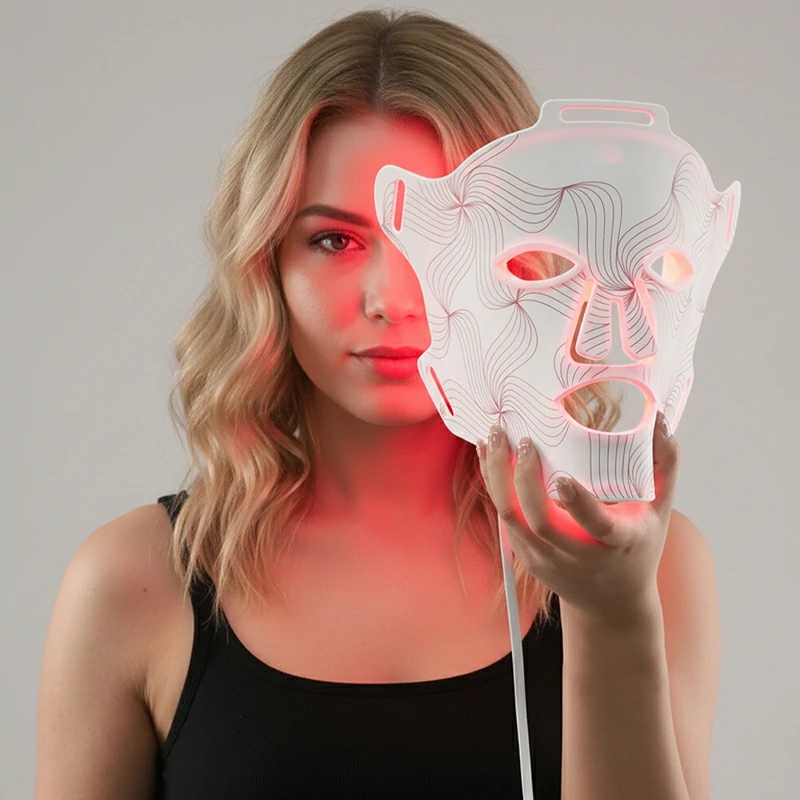
For those seeking a mask that combines power with unparalleled comfort, the G15 Red Light Therapy Silicone Mask is the pinnacle of our engineering.
Unlike rigid plastic alternatives that can feel heavy and restrictive, the G15 features a medical-grade silicone construction. This design ensures the mask contours perfectly to your unique facial anatomy, maximizing light penetration by keeping the LEDs at an optimal distance from the skin. As noted in clinical settings, a perfect anatomical match between the LED array and facial skin is essential for achieving the correct irradiation dose .
-
Design: Flexible, durable silicone for all-day comfort (during your 10-20 minute treatment!).
-
Coverage: Full-face coverage targeting wrinkle-prone zones.
-
Ideal For: Users who want a comfortable, “second-skin” feel that allows for slight movement during treatment.
|
Wavelengths
|
415nm:590nm:66onm:850nm=1:1:1:1
|
|
LED Color
|
Bule light,Organe light,Red ligth, Near-infrared light
|
|
LED Qty
|
186pcs
|
|
Power Consumption
|
8w
|
|
Dimensions
|
1310*207*4.5mm Face piece
350*260*4.5mm Neck piece
|
|
Product Weight
|
0.38kg
|
|
Beam Angle
|
105°
|
|
USB
|
TypC-C USB
|
|
lnput Voltage
|
5V 2A
|
|
Battery Capacity
|
5000mAh/7-10 times
|
|
Product Function
|
6 Skincare Modes,Brightness Adjustment,Pulse Function
|
|
Product name
|
Led Facial Mask
|
|
Material
|
Silicone
|
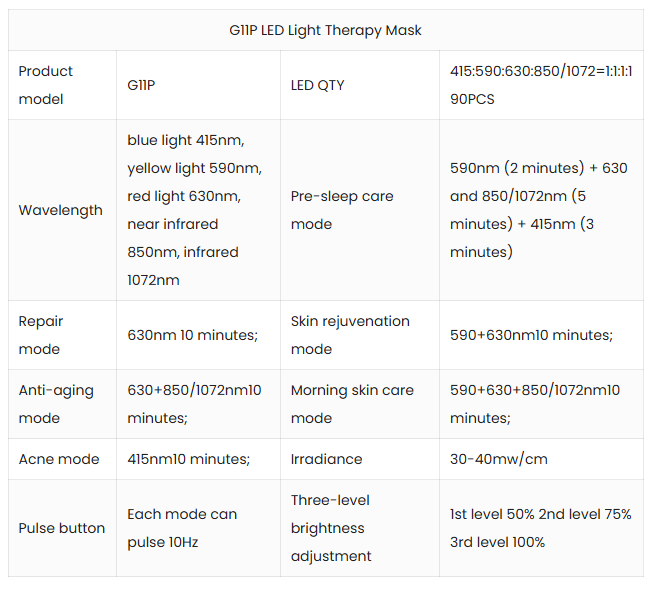
Targeted Precision: G11 Red Light Therapy Mask
If you are looking for the same FDA-cleared technology with a slightly different form factor, the G11 Red Light Therapy Mask offers a fantastic solution. Also listed under the same FDA clearance (K250830), the G11 is engineered for efficacy .
This model is designed for those who prioritize a specific fit and the assurance of a device that has met the stringent requirements of the FDA’s General and Plastic Surgery panel .
The Science of Rejuvenation: How These Masks Work
Why does the FDA pay such close attention to these devices? Because the science is sound. Red light therapy works at the cellular level through a process called photobiomodulation.
-
Cellular Energy Boost: The red and near-infrared light (typically in the 630nm-660nm and 830nm-880nm ranges) penetrates the skin and is absorbed by the mitochondria—the powerhouses of your cells .
-
Collagen Production: This energy stimulates fibroblasts, the cells responsible for producing collagen and elastin . Collagen is the structural protein that keeps skin firm and plump.
-
Visible Results: Studies on FDA-cleared LED masks have shown significant improvements in skin texture, tone, and a reduction in the appearance of fine lines and wrinkles .
By using the G11 or G15 consistently, you are effectively “charging” your skin cells to repair the visible signs of aging.
Why Silicone? The G15 Advantage
You might notice that the G15 Red Light Therapy Silicone Mask emphasizes its material. There is a reason for that.
Many hard-shell masks on the market, while effective, can feel heavy (some weigh over 500 grams) and may not sit flush on the skin . The G15″s silicone construction offers several distinct advantages:
-
Even Light Distribution: The flexibility ensures the lights stay close to the skin across the entire face, preventing light leakage and ensuring you receive the full therapeutic dose.
-
Comfort: You can relax, read a book, or even do light chores while wearing the mask without the rigid pressure of a plastic shell.
-
Hygiene: Silicone is easy to clean and maintain.
How to Use Your FDA-Cleared Mask for Best Results
Owning an FDA-cleared device is the first step; consistency is the second. Dermatologists emphasize that “patients who commit to a regular LED routine often see improvements in texture, tone, and radiance within a few weeks” .
-
Cleanse: Start with a clean, dry face. Avoid applying heavy creams or oils beforehand, as these can create a barrier.
-
Wear: Secure your G11 LED Mask or G15 Silicone Mask comfortably on your face.
-
Relax: Use the mask for the recommended session time (typically 10-20 minutes). This is your time to relax.
-
Repeat: For optimal anti-aging results, consistency is key. Most users benefit from 4-6 sessions per week.
-
Moisturize: Follow up with your favorite serum or moisturizer. Some studies suggest the skin may absorb products better post-treatment.
Frequently Asked Questions
Q:Do Red Light Masks Truly Work?
A:LED face masks employ Light Emitting Diodes (LEDs) to deliver precise wavelengths of energy directly to the skin. This energy penetrates to various depths, initiating biochemical reactions at a cellular level. Think of it as photosynthesis for your skin cells, with different coloured lights targeting distinct skin concerns.
We also recommend making sure the device you’re considering is FDA-cleared. FDA clearance means the FDA has cleared the device for marketing and that it’s safe to use. There’s a 510(k) or Premarket Notification process they go through to get it. You can check the database to see what’s FDA-cleared. It’s not the same as FDA-approved, which is a higher standard that takes more testing and research. We haven’t seen FDA approval for LED masks yet, but we have seen clearance.
Q:What Is the Most Effective LED Light Wavelength?
A:These are the typical wavelengths, measured in nanometers, to look for:
Red light therapy commonly uses wavelengths in the 630- to 660-nm range, with the lowest effective wavelength around 600 nm.
Near-infrared red lights are commonly 800 to 1,400 nm. These penetrate deeper into the skin and are used mostly for healing and reducing inflammation.
Blue light is typically 405 to 420 nm to kill acne-causing bacteria.
Q:What Are the Different Types of LED Lights?
A:AccordionItemContainerButtonResearch funded by NASA has revealed that red light can also speed up the wound healing process in some injuries. “High-intensity red and near-infrared LEDs significantly accelerated the healing of oxygen-deprived wounds in rats and also sped the growth and proliferation of skin, bone, and muscle cell cultures from mice and rats,” it was reported. NASA supplied LED devices to the US Navy to treat training injuries. Those who used the LEDs had a 40 percent improvement in musculoskeletal injuries and 50 percent faster healing for lacerations over the control group.
Blue light, on the other hand, penetrates the epidermis, the top layer of skin, killing acne-causing bacteria. “It also reportedly helps to regulate oil production and reduce inflammation, leading to clearer skin,” says Shoshana Marmon, a board-certified dermatologist and assistant professor of dermatology at New York Medical College.
There are other lesser-known LED lights, such as green, yellow, and purple; red and blue LEDs are backed up by clinical studies.
Q:How to Properly Use an At-Home LED Mask?
A:Follow the directions for the specific device you’re using, but in general, you’ll want to wash and dry your face and use the mask before applying any skin care products. LED therapy devices should have a set treatment time, usually between three and 10 minutes. Use it for the full time unless it feels uncomfortable. After, apply your skin care products as normal, focusing on hydration (serums and moisturizers), especially if you’re prone to dryness. Do not use these masks longer than indicated in their directions.
Q:How Often Should You Use an LED Face Mask?
A:AccordionItem Container Button LED light therapy face masks don’t work for everyone, but consistency is crucial if you want to try it. Follow manufacturer guidelines for best use, but most dermatologists recommend using an LED face mask three to five times per week for up to 12 weeks to see results.