Si vous avez fait des recherches sur la thérapie par la lumière rouge, vous avez probablement rencontré deux chiffres à plusieurs reprises: 660nm et 850 nm. Ces longueurs d'onde représentent les options les plus scientifiquement validées et les plus couramment utilisées en matière de photobiomodulation pour la santé de la peau.. Mais que font-ils exactement, et plus important encore, de quel produit votre peau a-t-elle besoin?
La réponse pourrait vous surprendre: il ne s'agit pas de choisir l'un plutôt que l'autre, mais comprendre comment ils travaillent ensemble. Plongeons en profondeur dans la science de la lumière rouge à 660 nm par rapport à la thérapie proche infrarouge à 850 nm pour le rajeunissement de la peau..
Les fondamentaux: Comment la lumière interagit avec la peau
Avant de comparer les longueurs d'onde, il est essentiel de comprendre que la luminothérapie fonctionne par photobiomodulation, un processus par lequel des longueurs d'onde spécifiques de la lumière sont absorbées par les mitochondries de vos cellules., déclencher une cascade de réponses biologiques bénéfiques .
Quand les photons lumineux pénètrent dans votre peau, ils sont absorbés par le cytochrome c oxydase, une enzyme clé dans la chaîne respiratoire mitochondriale . Cette absorption augmente l'ATP (énergie cellulaire) production, réduit le stress oxydatif, et module l'inflammation . Cependant, différentes longueurs d'onde pénètrent à différentes profondeurs et affectent différents types de cellules .
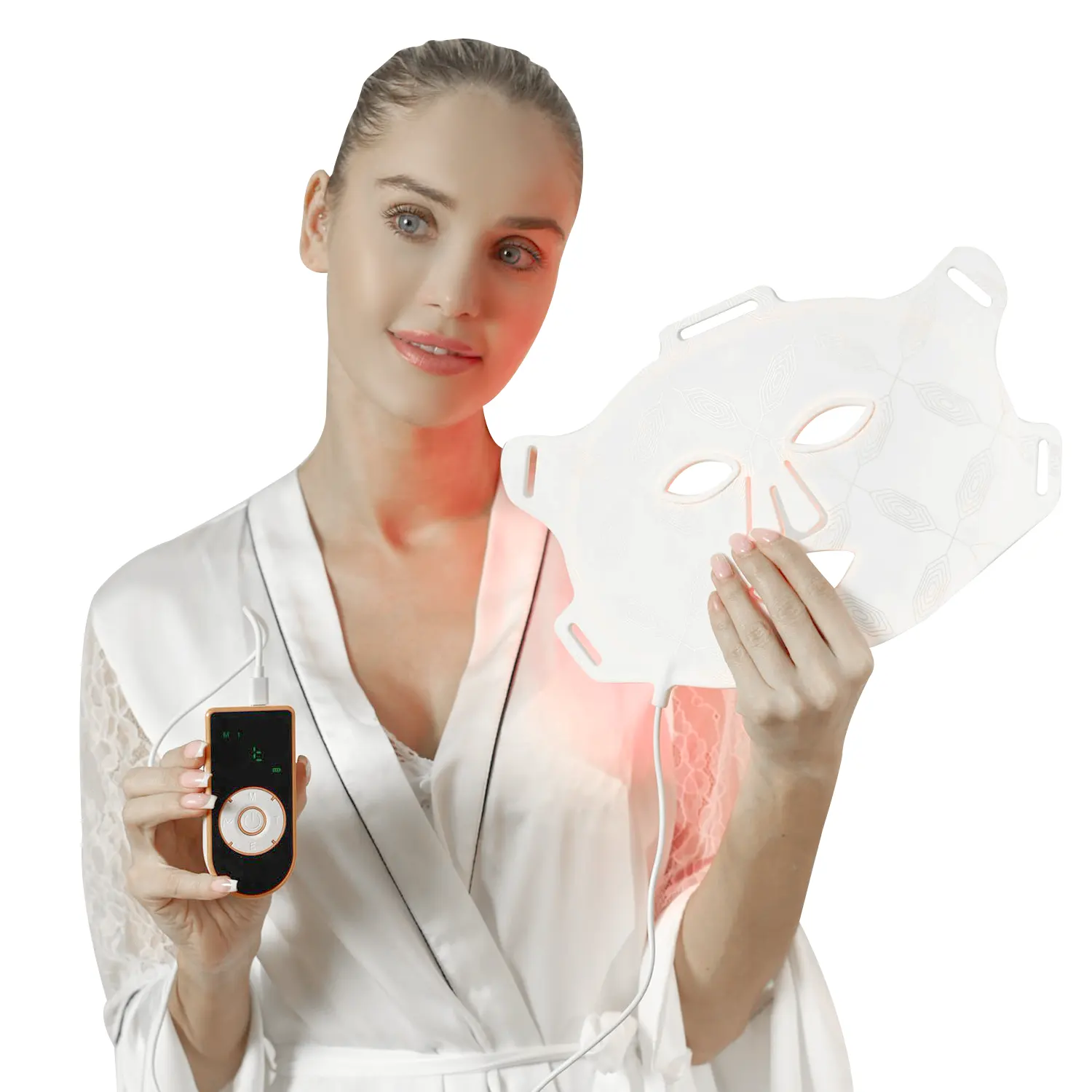
Qu'est-ce que la lumière rouge 660 nm?
660nm se situe dans le spectre de la lumière rouge visible et est largement utilisé dans la photobiomodulation axée sur les soins de la peau.
Caractéristiques clés du 660 nm
-
Lumière rouge visible
-
Pénètre environ 2–5 mm dans la peau
-
Cible le épiderme et derme supérieur
Avantages pour la peau de 660 nm
660nm est principalement associé à améliorations cosmétiques de la peau, y compris:
-
stimuler la production de collagène
-
réduire les rides et ridules
-
améliorer le teint et la texture de la peau
-
améliorer l'élasticité de la peau
-
favoriser la réparation au niveau de la surface
En raison de sa profondeur de pénétration, 660nm est idéal pour soins anti-âge et rajeunissement de la peau.
Qu'est-ce que la lumière proche infrarouge de 850 nm?
850nm appartient au proche infrarouge (NIR) spectre, invisible à l'œil humain mais très efficace pour la stimulation des tissus plus profonds.
Caractéristiques clés du 850 nm
-
Lumière invisible proche infrarouge
-
Pénètre jusqu'à 5–10 mm ou plus
-
Atteint le derme profond et couches sous-cutanées
Peau & Avantages tissulaires de 850 nm
850nm travaille sous la surface, justificatif:
-
réparation des tissus profonds
-
inflammation réduite
-
amélioration de la circulation sanguine
-
processus de récupération plus rapides
-
régénération cellulaire améliorée
Bien que cela n'améliore pas directement l'apparence de la surface comme le 660 nm, il soutient la structure sous-jacente de la peau, ce qui le rend essentiel pour la santé de la peau à long terme.
660nm contre 850 nm: Comparaison côte à côte
| Fonctionnalité | 660feu rouge | 850nm Proche infrarouge |
|---|---|---|
| Type de lumière | Rouge visible | Infrarouge invisible |
| Profondeur de pénétration | 2–5mm | 5–10mm+ |
| Zone cible | Épiderme & derme supérieur | Derme profond & tissu |
| Avantage principal | Anti-âge & collagène | Réparation & récupération |
| Meilleure utilisation | Rides, teint | Inflammation, réparation en profondeur |
Pourquoi les meilleurs appareils combinent les deux
Le véritable pouvoir de la thérapie par la lumière rouge vient de combinant 660 nm et 850 nm.
Pourquoi?
Parce que la santé de la peau n’est pas seulement une question d’apparence de surface, c’est aussi une question de que se passe-t-il en dessous.
660nm poignées:
-
améliorations visibles de la peau
-
synthèse de collagène
-
raffinement de la texture
850nm poignées:
-
réparation des tissus plus profonds
-
réduction de l'inflammation
-
soutien cutané à long terme
Ensemble, ils créent un système de thérapie cutanée à spectre complet.
Comment les masques LED professionnels utilisent ces longueurs d'onde
Les masques LED modernes sont conçus pour combiner plusieurs longueurs d'onde en un seul appareil, permettant aux utilisateurs de cibler plusieurs couches de peau simultanément.
Vous trouverez ci-dessous des exemples de la manière dont les masques LED avancés intègrent ces technologies.
Exemple 1: Masque en silicone de thérapie par la lumière rouge G13
Le Masque LED G13 est conçu avec un système multi-longueurs d'onde, y compris la lumière visible et proche infrarouge.
Spécifications clés
-
Quantité de LED: 104 LED
-
Longueurs d'onde: 530 / 590 / 660 / 830nm
-
Matériel: Silicone souple
-
Modes: 4 Modes + réglage de la luminosité
Pourquoi c'est important
-
660feu rouge soutient le collagène et l’anti-âge
-
830nm proche infrarouge offre une pénétration plus profonde similaire à 850 nm
-
Le silicone flexible assure contact étroit avec la peau pour une meilleure absorption
Cela fait du G13 une option intéressante pour applications de soins de la peau équilibrées.
Exemple 2: Masque de luminothérapie LED G10
Le Masque LED G10 est conçu pour thérapie cutanée à spectre complet, combinant plusieurs longueurs d'onde cliniquement pertinentes.
Spécifications clés
-
Nombre de LED: 128 LED à double puce
-
Longueurs d'onde: 590 / 630 / 830 / 850nm
-
Matériel: Silicone de qualité alimentaire
-
Batterie: 3000Batterie rechargeable
-
Structure: Circuit imprimé FPC flexible
Pourquoi c'est important
-
Combine feu rouge (630nm) avec proche infrarouge (850nm)
-
Prend en charge les deux rajeunissement de surface et réparation en profondeur
-
La haute densité de LED garantit répartition uniforme de la lumière
Pour les marques et les distributeurs, ce type d'appareil offre un solution anti-âge complète dans un seul masque.
Quelle longueur d'onde est la meilleure pour la peau?
C'est là que de nombreux acheteurs se trompent.
Il ne s’agit pas de choisir entre 660 nm et 850 nm.
Il s'agit de comprendre votre objectif.
Choisissez 660 nm si votre objectif est:
-
rides et ridules
-
teint et luminosité de la peau
-
anti-âge en surface
Choisissez 850 nm si votre objectif est:
-
inflammation
-
réparation cutanée plus profonde
-
santé de la peau à long terme
Choisissez les DEUX si vous voulez:
-
thérapie cutanée complète
-
résultats visibles plus rapidement
-
amélioration structurelle à long terme
Le rôle de la densité de puissance
La longueur d’onde seule ne suffit pas.
Pour obtenir de vrais résultats, l'appareil doit fournir suffisamment irradiation (mW/cm²).
Plages efficaces typiques:
-
30–50 mW/cm² → applications de soins de la peau
-
50+ mW/cm² → stimulation des tissus plus profonds
Les masques LED professionnels sont conçus pour maintenir une sortie stable sur l'ensemble du visage, assurer un traitement cohérent.
Pourquoi l'ajustement et le matériau sont également importants
Même avec les bonnes longueurs d'onde, une mauvaise conception du masque peut réduire l’efficacité.
Les facteurs clés comprennent:
1. Ajustement du visage
-
Les masques en silicone flexibles s'améliorent absorption de la lumière
-
Réduire les pertes d'énergie dues aux lacunes
2. Sécurité des matériaux
-
Silicone de qualité alimentaire ou médicale
-
Faible émission de chaleur
-
Matériaux de contact sans danger pour la peau
3. Distribution LED
-
Un placement uniforme garantit traitement uniforme
-
Empêche les résultats inégaux
Les appareils comme le G10 et le G13 intègrent structures flexibles et agencements LED optimisés, qui améliorent considérablement les performances du monde réel.
Erreurs courantes lors du choix d'un masque de thérapie par la lumière rouge
De nombreux acheteurs se concentrent sur les allégations marketing plutôt que sur les spécifications techniques..
Évitez ces erreurs courantes:
❌ Choix basé sur le nombre de couleurs uniquement
❌ Ignorer la précision de la longueur d'onde
❌ Surplomber la densité de puissance
❌ Acheter des masques rigides mal ajustés
❌ Ignorer la sécurité et la conformité
L’avenir de la thérapie cutanée LED
L'industrie des soins de la peau à LED évolue rapidement vers:
-
systèmes multi-longueurs d'onde
-
conceptions portables flexibles
-
densité de LED plus élevée
-
systèmes de batterie améliorés
-
appareils domestiques de qualité clinique
La combinaison de 660nm + 850nm devient la norme de l'industrie pour masques avancés de thérapie par la lumière rouge.
Pensées finales
En comparant 660Thérapie par lumière rouge nm vs 850 nm pour la peau, l'essentiel à retenir est simple:
Ce ne sont pas des concurrents, ce sont des technologies complémentaires.
-
660nm améliore ce que vous voyez
-
850nm prend en charge ce que vous ne voyez pas
Ensemble, ils créent un système complet pour:
-
anti-âge
-
réparation de la peau
-
santé de la peau à long terme
Pour les marques de soins de la peau, distributeurs, et les consommateurs, choisir un appareil qui combine les deux longueurs d'onde, comme les masques LED avancés comme le G13 ou le G10, garantit des résultats plus efficaces et cohérents.
Citations:
[1] Souhait, UN., & Matouschka, K. (2014). Un essai contrôlé pour déterminer l'efficacité du traitement par la lumière rouge et proche infrarouge sur la satisfaction des patients, Réduction des ridules, Rides, Rugosité de la peau, et augmentation de la densité intradermique du collagène. Photomédecine et chirurgie au laser, 32(2), 93–100.
[2] Kwon, H. H., et autres. (2013). L'effet clinique et histologique de l'utilisation à domicile, Photothérapie combinée à LED bleu-rouge pour l'acné vulgaire légère à modérée chez les patients coréens: un double aveugle, essai contrôlé randomisé. Journal britannique de dermatologie, 168(5), 1088–1094.
[3] Chasseur, P., et autres. (2013). Laser de bas niveau (lumière) thérapie (LLT) dans la peau: stimulant, guérison, restauration. Séminaires en médecine cutanée et chirurgie, 32(1), 41–52.
[4] Lee, S. Y., et autres. (2013). Évaluation clinique d'un appareil de luminothérapie de faible intensité auto-appliqué à usage domestique pour la réduction des rides. Chirurgie dermatologique, 39(11), 1657–1664.
[5] Sadique, N. S., et autres. (2015). Une étude visant à déterminer l'efficacité d'un nouveau dispositif portatif à diode électroluminescente dans le traitement de la peau photovieillie. Lasers en chirurgie et en médecine, 47(6), 496–502.
[6] Or, M.. H., et autres. (2018). Efficacité clinique de la thérapie par la lumière bleue à usage domestique pour l'acné légère à modérée. Journal de dermatologie clinique et esthétique, 11(5), 23–28.
[7] Ablon, G. (2019). La photothérapie combinée à diodes électroluminescentes de 830 nm et 633 nm s'avère prometteuse dans le traitement du psoriasis récalcitrant: conclusions préliminaires. Journal des médicaments en dermatologie, 18(2), 172–176.
[8] Barolet, D., et autres. (2020). Régulation du métabolisme du collagène cutané in vitro à l'aide d'un 660 source de lumière LED nm. Journal de dermatologie cosmétique, 19(6), 1351–1359.